DCUL News and Updates
Upcoming Trips/Events
Saturday, January 24th — Social: Potluck and “Big Trip” Celebration
Saturday, February 7th — MO V1: Assateague
Friday, February 20th — Social: Blackwater Falls Winter Weekend
Saturday, March 21st — Wilderness First Aid Certification Class
Friday, May 22nd — VMO: C&O canal towpath bikepacking
Friday, June 5th — IO/VMO: Isle Royale Loop (100+ miles)
Event Spotlight
Saturday, January 24th — Social: Potluck and “Big Trip” Celebration
I’m excited to revive a DCUL tradition — our annual potluck and “big trip” slideshow. You’ll get to munch on tasty treats while seeing brief presentations from 2025 “big trips,” including Tour du Mont Blanc, Nepal, the Wonderland Trail, and adventures in Colorado and Arizona.
It’s a great opportunity to socialize, meet other club members, and learn about trips that may be on your bucket list. And who knows–maybe a few plans for 2026 and 2027 trips, domestic or international, will take shape.
This will be a potluck, so post what you’re planning to bring in the comments. The building is easily accessible by metro—just two blocks from the Eisenhower metro or a short walk from the King Street metro. Limited street parking is available, but there are parking garages nearby.
A Guide to Trip Rankings
If you are a new member to DCUL, the obscure letters that one sees in the titles of each trip may be a little confusing (I know it was for me when I first started). What does LM, MO, or VMO mean? And now that we are in Winter, what does W1 LM mean? I’ll do my best to articulate their meanings in the simplest way possible.
DCUL uses a ranking system to categorize trips based on “skills required.” I used “skills required” instead of “difficulty” because sometimes people associate the number of miles on a trip with difficulty. While hiking 20 miles a day sounds harder than hiking only 10 miles a day, this fails to account for other factors such as elevation, trail conditions, weather, and any other special circumstances i.e off trail hiking.
The four general categories are:
Low Mileage (LM): If you’re new to DCUL, this will be the first trip you do with the club. Typically, these are trips that don’t exceed more than 25 miles and often this will be a Saturday start and Sunday end. One should expect to hike no more than 18 miles per day (Usually it is around 10-15 miles per day). While these trips are open to anyone in the club, they are requirements for all new members. LM trips serve as a nice introduction to DCUL. Example LM trip: White Rock Cliffs
Members Only (MO): These trips usually range from 25-35 miles and entail 2 nights spent outside (Friday evening start and Sunday end). After new members complete their first LM trip, get approved, and pay their dues to the club, they become DCUL members and are able to join MO trips. Trip participants on MO trips are expected to be able to read a map and hike confidently solo. Example MO trip: Virginia Triple Crown
Veteran Members Only (VMO): Members who have developed enough experience can eventually become Veteran Members. This upgrade usually occurs when the member has logged trips that include 20+ mile days, shown competence with their gear, and demonstrate strong navigation skills. VMO trips are usually 40 miles or more. Example VMO trip: Black Forest Trail
Invite Only (IO): To go on these trips, one needs to be invited or approved by the organizer. These are typically weeklong trips around the country or international trips. Example IO: Wonderland Trail
In the wintertime we have additional rankings to accurately describe how conditions affect the trip. Anyone signing up for a winter trip needs to be able to provide the trip leader with a gear list indicating that you have the appropriately rated gear for the conditions anticipated. This applies to everyone. If you do not provide a gear list (and if you’re not responsive to the organizer), you won’t be doing the trip.
Winter 1 (W1): This rating corresponds to the winter conditions we usually see in Virginia, Maryland, and nearby portions of Pennsylvania. It will be cold, with temperatures below freezing at times, perhaps down to the teens. While you could use your usual three season gear (pack, tent, stove), you will need to supplement your sleep and layering systems to handle colder temperatures. To that end, you will need to supply a detailed gear list (gear + temperature ratings) to the organizer in order to participate.
Winter 2 (W2): For this rating, we are anticipating conditions that resemble W1 conditions (not so much snow to justify snowshoes or skis), and where we expect the trail to be icy or the temps to be in the teens or lower. W2 trips also differ from W1 trips in that they require an investment in serious gear to safely handle the conditions and a good understanding of how to use that gear. These trips are for members who have prior winter experience, made significant investments in gear, and display good knowledge of how to manage their gear in winter conditions.
Winter 3 (W3): This rating corresponds to the winter conditions we might expect to find in some parts of West Virginia, farther north in Pennsylvania, or New York and New England. To do these trips, you will need to have made a considerable investment in gear (especially bag and pad) capable of keeping you warm at very cold temperatures. Expect to be sleeping on significant snow accumulation. Trail runners are out: you’ll need appropriate footwear for snow shoes and skis, which may very well be required. Some variety of insulated boots are in order. Down booties are a must. Your stove should be capable of melting snow to get water. You should have done a number of trips at the W1 level before you do a W3 trip.
Winter 4 (W4): Indicates a winter trip where we require some additional training. This might include avalanche training, basic mountaineering, or ice climbing.
The vast majority of winter trips are W1 and W2 trips. More detail into each ranking can be found here on our website. It is also important to note that the trip organizer is ultimately the decider on the trip ranking. Everyone assesses risk differently and may rank things slightly different from the recommendations outlined here. It is important to talk to the trip organizer to understand how they decided to rank a trip. Remember, mileage isn’t everything. Our annual Tour De Sods trip is ~35 miles which is the same amount of miles as the Virginia Triple Crown. However the Tour De Sods requires significantly more skill and experience to hike it.
Hiking Through History
The Appalachian Trail Hall of Fame
By Chandler S
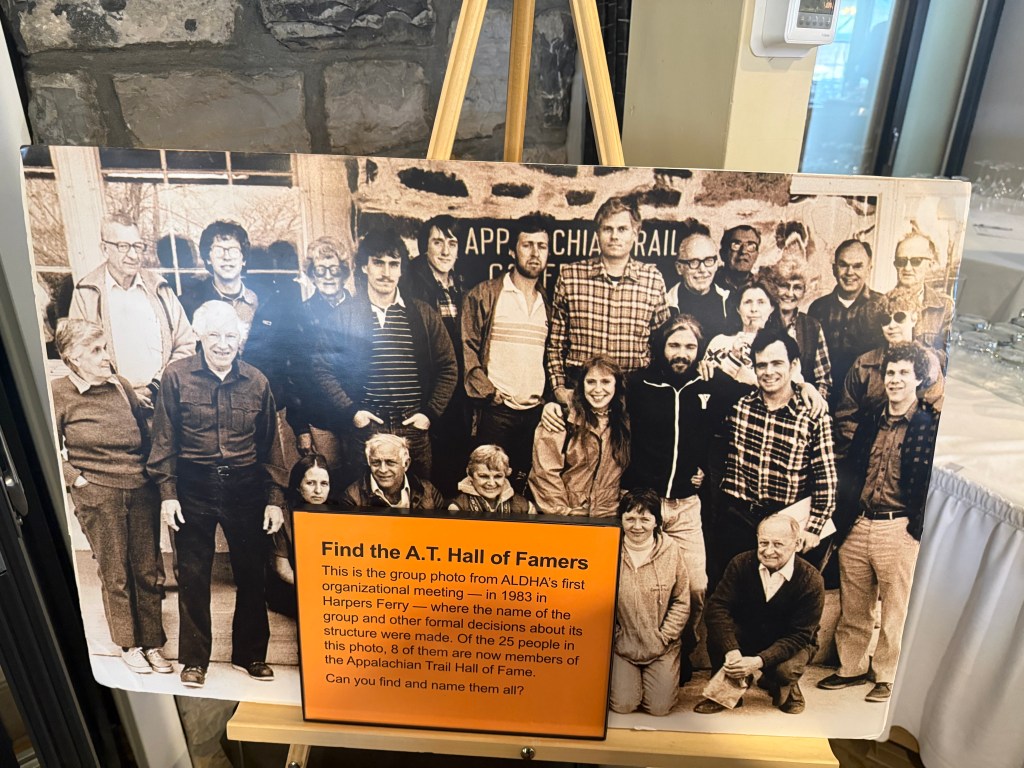
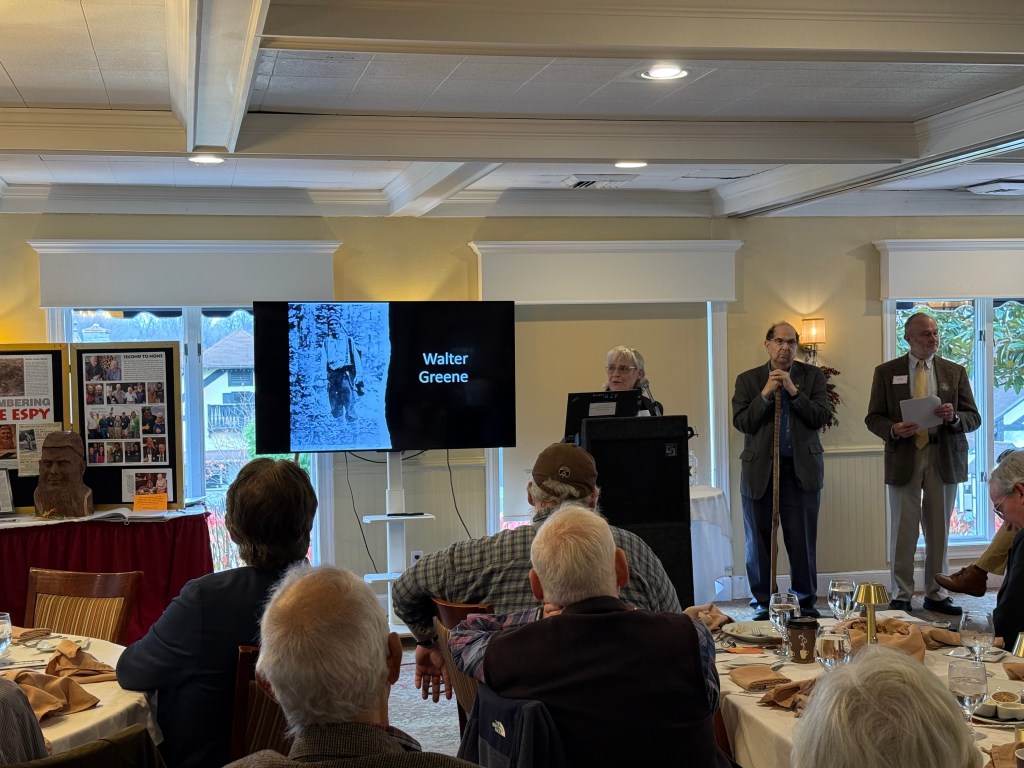
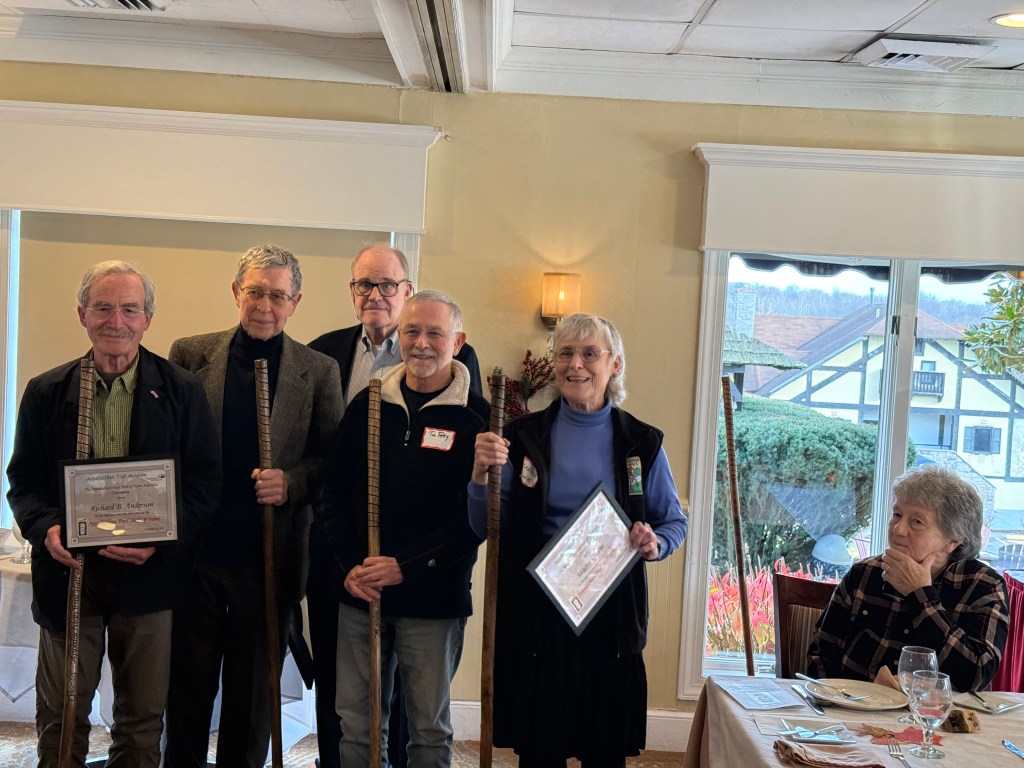
In November, I was fortunate to attend the Appalachian Trail Hall of Fame in Shepherdstown, West Virginia. It was a random blessing to be invited to this event because tickets sold out fast. The Partnership for the National Trails System (PNTS), a nonprofit I volunteer with, gave me one of their extra tickets because I have volunteered and worked with them for the past year. PNTS asked me to represent them and take as many photos of the event as possible. The following people were being inducted into the Appalachian Trail Hall of Fame:
Ron Tipton: One of the founding members of the Appalachian Long Distance Hikers Association (ALDHA), former Senior Staff at the Wilderness Society and the National Parks Conservation Association, former Board Member of the Partnership of the National Trails System (PNTS), and former CEO of the Appalachian Trail Conservancy.
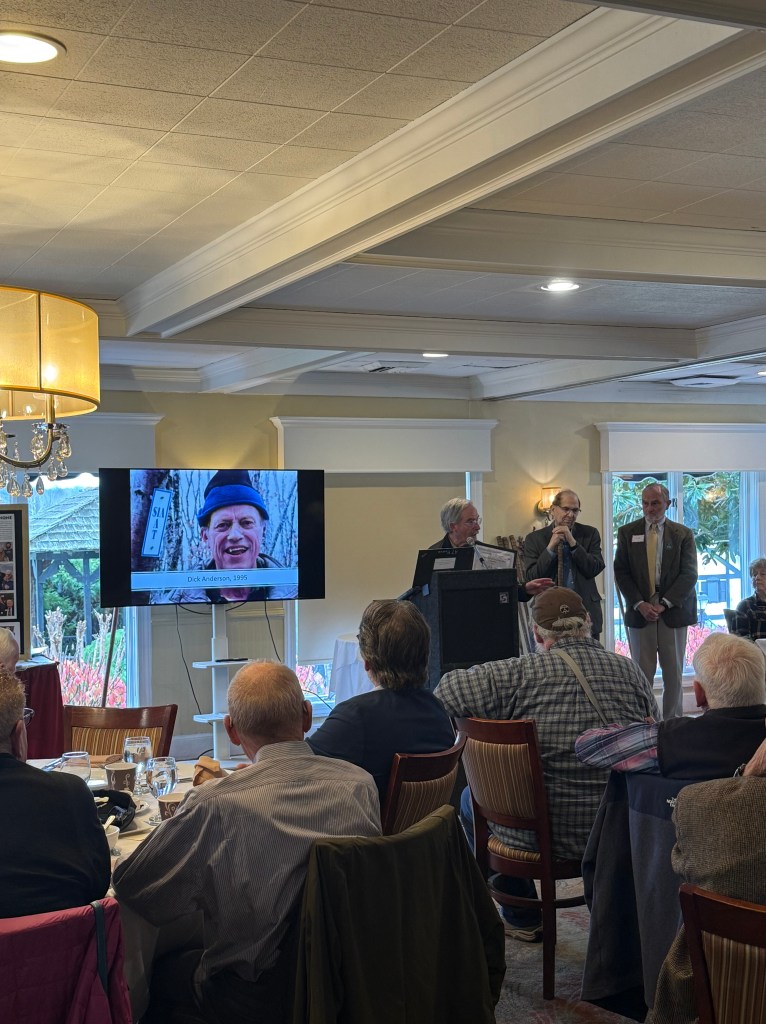
Richard Anderson: Commissioner of the Maine Department of Conservation and co-founder of the International Appalachian Trail (IAT). 200 million years ago, when the world was a single supercontinent, the Appalachian Mountains were part of the Central Pangean Range. The IAT connects North America’s Appalachian Mountains with remnants of the Central Pangean Range in other countries. Richard Anderson helped create a trail connecting Maine’s Katahdin to Mont Carleton in New Brunswick and then on to Mount Jacques Cartier in Quebec’s Gaspé Peninsula. Other countries have embraced the IAT, and today it has 23 chapters across three continents.
Walter Greene: The story of Walter Greene is one of inspiration and tragedy. A Broadway actor by trade, Walter Greene spent his off-seasons in the forests of Maine, where he kept to himself in a quaint cabin. He befriended Myron Avery, the “mover” of the Appalachian Trail and founder of the Potomac Appalachian Trail Club (PATC), and Avery convinced Greene to construct miles of trail in Maine for the Appalachian Trail. I have read letters between Greene and Avery. It’s worth noting that Avery, a man famous for his rude and abrasive nature, showed genuine kinship and gentleness toward Greene, especially during Greene’s dying days (a great Appalachian Trail book is Blazing Ahead: Benton MacKaye, Myron Avery, and the Rivalry That Built the Appalachian Trail). From 1932-1937, Walter Greene did more for the trail than many did in their entire life. He died alone in a New York nursing facility in 1941 from colon cancer. Greene was also notably the first President of the Maine Appalachian Trail Club.
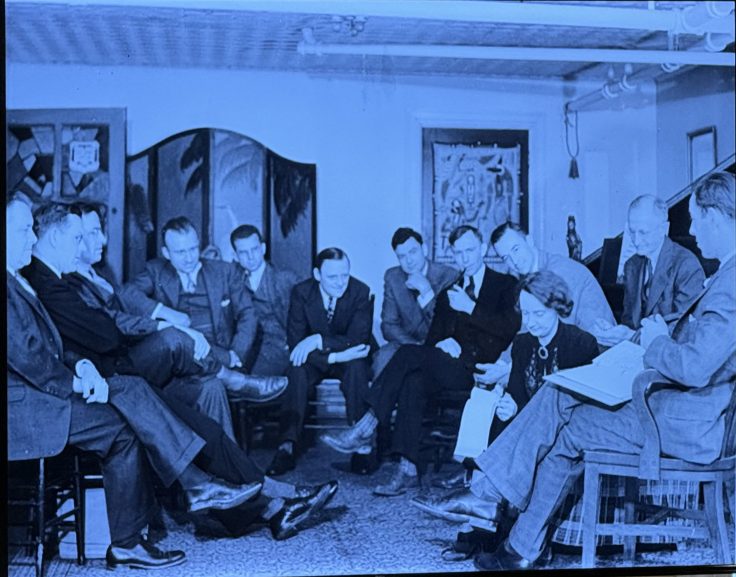
Marion Park: When we look at the history of the Appalachian Trail, we often think of the men who created it. In our defense, Benton Mackaye and Myron Avery, both men, take up considerable real estate in the minds of Appalachian Trail history lovers. But behind the founders of the trail are the people who did the work constructing the trail we love today. In Virginia, women did much of that work. In fact, the Potomac Appalachian Trail Club (PATC), a club founded by Myron Avery, was full of women in its heyday.
The year was 1918, and a club was formed in Washington, DC: the Wildflower Preservation Society. In 1927, when Avery was formulating ideas to build sections of the AT in Virginia, it was the President of the Wildflower Preservation Society who helped him get his ideas off the ground and construct the trail. The members of the Wildflower Preservation, who were largely women, would eventually become members of the Potomac Appalachian Trail Club (PATC) and build sections of the Virginia AT.
Marion Park was one of those women in the PATC who edited the club’s newsletter starting in 1933. She eventually became the secretary of the Appalachian Trail Conservancy (ATC) from 1941 to 1955. Her job was to document all ATC (and cross-over PATC) meetings. Still, it also included her going out into the field with renowned speed-hiker Myron Avery, taking notes as he measured and identified deficiencies. Her notes became the basis for ATC maps, guidebooks, and governance documents for the first three decades of PATC.
George Masa Documentary
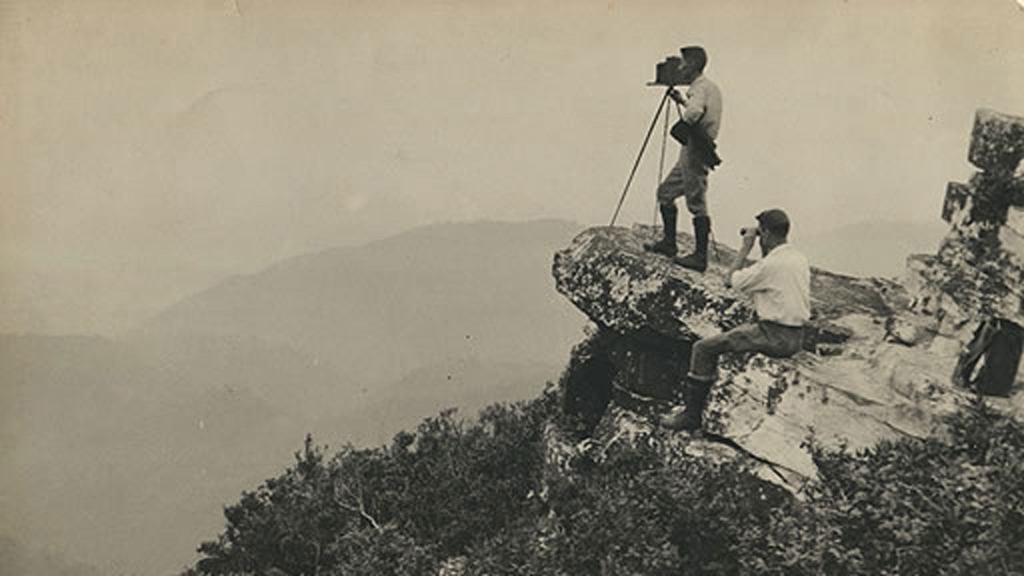
In addition to the Hall of Fame induction, I watched a documentary on George Masa, a Japanese immigrant in the early 20th century whose photos of the Great Smoky Mountains helped make the area a National Park. Additionally, George Masa would assist Myron Avery in constructing sections of the Appalachian Trail in North Carolina. A great book about George Masa is available here, and the documentary is slated for release sometime this year. I highly recommend everyone to read a little about this man and view the photographs he took of the Smoky Mountains. Here is an excellent article with photos.
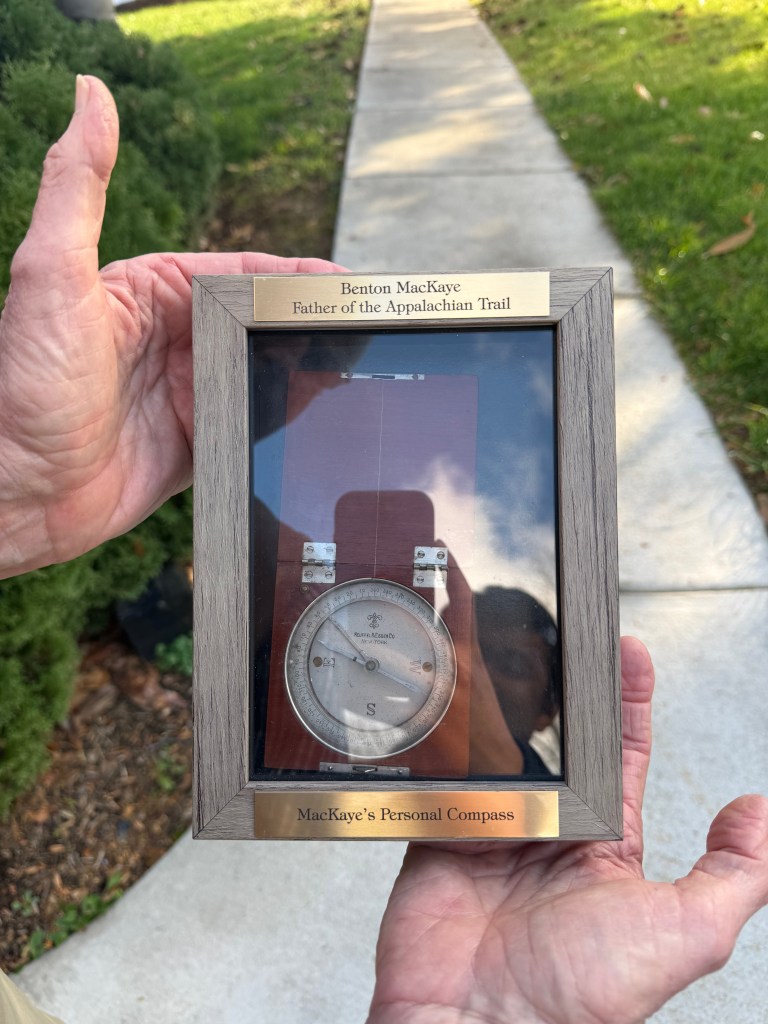
In addition to all the Hall of Fame inductions and documentary screening, I got to hold Benton Mackaye’s personal compass. It was such a privilege to attend this sort of event, and I am always humbled learning about the people who comprise this special trail. Thank you to Scout and Frodo for hosting me this day.
Member Spotlight
Meet VM Maddie
When and why did you join DCUL?
I joined DCUL after graduating college in 2020 but didn’t really become active until 2022 when my friends who I hiked with a lot moved away and I didn’t want to go by myself. But I wish I had started going on more trips sooner!
What is your favorite trail in the Mid-Atlantic region?
It is so hard to pick so I will do two. My favorite local weekend spot is the Doyles River/Brown Mountain/Rockytop loop in Shenandoah NP and my favorite longer trail that I have done so far is the Quehanna trail in PA.
You recently did the 4 state challenge for the first time, what’s one thing you were surprised about the trip? High and low point of the trip?
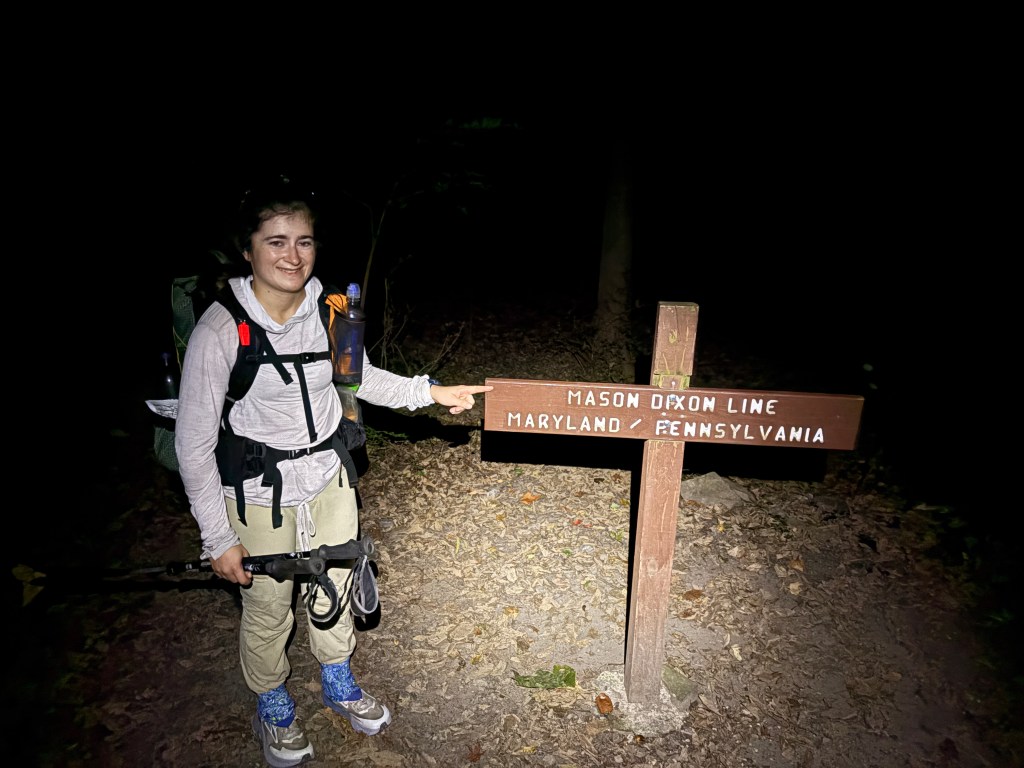
One thing I was surprised about the 4 state challenge was how much I was still able to appreciate about the hike despite my feet being in a lot of pain. I grew up in MD and in scouts, we would always hike that section of the AT but it had been maybe 10 years or so since I had done a long hike there. It is a really beautiful section of trail with all the civil war history, big trees, cool rock formations, and views off the ridge. Watching the sun rise and set all while still pressing on to the goal felt very peaceful and rewarding and not demoralizing like I was expecting. I won’t lie though it was very difficult. Despite all the warnings from 4 state veterans, the rock garden right in the last couple of miles was still an unpleasant surprise. That was definitely the low point. My feet were in a lot of pain pretty much the whole second half, which was not awesome. My high point was seeing the aid station at the 270 overpass and getting cheered on by DCUL friends and drinking some coffee. At that point I knew I was going to be able to make it the rest of the way.
I know you ran the taco bell 50k. Why did you do this?
My coworkers actually told me about the taco bell 50K and said I should do it after we talked about the 4 state challenge. This was an unofficial 50K that connected 9 taco bells in VA and DC, and you had to eat a menu item at every taco bell. Unfortunately due to it being Thanksgiving weekend, I couldn’t round up anyone to do it with me but my apartment is pretty much right at the halfway point so I figured, what the heck why not give it a try? Worst case I just go home in the middle (and if it’s going well, I have a guaranteed clean private bathroom). I had never run more than like 15 miles at once but I figured with the generous time limit I could definitely walk it. And I’ve always been kind of a taco bell hater so I wanted to see if it could change my mind. And, it ended up being really fun! A hundred times easier than the 4 state challenge, especially psychologically! All the taco bell stops felt like a big party and there were a lot of first-time distance runners. In fact, I think I only talked to one person who had done a marathon before. I did kind of hit the wall on running and had to alternate walking in the last couple miles, but no foot pain or blisters. I would encourage everyone who likes taco bell, running, and/or doing dumb things to do it next year. If you can hike 30, you can definitely slow jog/walk 30 with 9 taco bell breaks. And taco bell is a lot better than I realized, I’ve been converted. Try the avocado sauce! I didn’t even get a tummy ache during the race.
Backpacking goals for 2026
I have 3 backpacking goals for 2026. First is completing the Loyalsock trail, which I’m looking forward to doing with some of you this summer or fall! Second is I want to do a weeklong trip in big mountains with friends or DCUL this summer. And third is, I want to figure out how to make my feet not hurt and get blisters. This has always been an issue for me and I was so surprised that it wasn’t a problem at the taco bell 50k. I think maybe this means I need my hiking gait to be more similar to my running gait? And I’m always trying new shoes and tapes and salves and socks all the time but so far, no silver bullet. If anyone has any tips let me know!
What does Ultralight mean to you?
Ultralight to me means that everything in the pack gets used and there are no unnecessary items, but also that I am reasonably comfortable the whole time. So what’s in my pack always changes depending on the goals of the trip. If it’s an LM trip and we’ll be hanging out in camp, adding a chair or a lot of down layers when it’s cold is worth it. But if we’re just going to be immediately rolling into bed after a long day, I don’t really need gear to be comfortable sitting around camp for a few hours. I do try after every trip to go through and assess everything I brought to check if I didn’t use something and can leave it behind next time. My splurge is that you will never catch me without my flextail mini pump. I will not blow up my pad by mouth like a peasant!
Sheetz or Wawa?
Sheetz because I like the cheese curds and cinnapockets. It might be bad but it has more variety
Opinion: The Ultralight Obsession in Gear Selection
By Chandler S
What does it mean to be ultralight? Some will simply say a base weight of 10 pounds or less, but what does that entail? Could I cowboy camp and then bring a heavier sleep system? Could I have a big three that is UL but cold-soak my meals and skip a complete cook system? Is it just about the whole and not about the parts? I raise these questions, not to argue for a definitive answer to any of them, but rather to demonstrate the ambiguity in the definition of what it means to be ultralight. I believe it is a good thing that we lack a definition of what is ultralight. Ultralight will constantly change, and assigning a number like 10 pounds is somewhat arbitrary. For much of the 20th century, having a base weight under 20 pounds was not just considered ultralight, but in fact a miracle! And in 10 years, the UL purists on Reddit might be scoffing at anyone’s base weight slightly over 5 pounds.
But in this postmodern attitude towards ultralight backpacking, gear companies have decided to capitalize on the lack of a standard. Going into REI, no product is safe from the word ultralight. Towels, spoons, socks, medical kits, and even five-person backpacking tents are labeled as ultralight (the mere fact that a 5-person backpacking tent can be labeled as ultralight is asinine and so clearly a pander to our ultralight obsession).
If you are a seasoned outdoors person, you can surmise if something is truly “ultralight” or not, but to many people who are first starting, the word ultralight attached to a product beckons their wallet. Like a moth to a flame, those new outdoors people instinctively gravitate towards the “ultralight” label only to realize later that they, in fact, burned $500 on a cramped semi-freestanding tent that they are miserable in.
There is nothing I can think of to combat this blatant marketing tactic by outdoor gear companies — it unfortunately works. Gear is getting progressively lighter across all outdoor activities, i.e., pack fabrics. But although lighter may be the future, balance is the ideal. Lighter gear doesn’t mean comfortable, nor does it mean one will hike that much faster. Many DCULers have “heavy” packs yet hike faster than some ultralighters in the club. A hilarious, but sad, sight is seeing a person fully decked out in Hyperlight Mountain Gear, still struggling to keep pace with everyone, and visibly annoyed by the lack of padding on their pack. This person has clearly been fed the Gospel of Ultralight and thrown thousands of dollars into gear that has not given them the return they wanted. There are many reasons why I would choose lighter gear over heavier gear, but if comfort starts to dip as a result of my ultralight choices, I believe the wrong decision has been made. To me, ultralight is about balance, and that balance is different for everyone. I like trekking pole tents, but others may not. Some like mummy-shaped sleeping pads; I need a rectangular-shaped one. We must strike that balance between weight and comfort and, to me, that is the value and purpose of ultralight in the backpacking world.
So when you are looking to lighten your backpacking gear, you will inevitably run into the word ‘ultralight’ in your research. It is essential to scrutinize the product’s specifications. Is down being used? If so, what fill power? Does the tent require its own poles, or could you use trekking poles? Is it double-walled or single-walled? What is the R-Value of the sleeping pad? These are the sorts of questions that I ask when I am doing my own research on gear. There are a handful of companies out there (mostly cottage companies) that, I would argue, don’t make egregious ultralight claims to their products, but even then, do your research and compare the products with one another. If a company uses the word ultralight to label a product, don’t believe them at face value. Let the specs prove it to you.
Thank you for reading! Happy New Year and may 2026 keep our packs light, gear dry, and feet blisterless. Please reach out to dcul.backpacking@gmail.com if you would like to contribute to the newsletter in any way. Remember to pay your dues. You can use this link to pay: https://www.paypal.me/JenniferAdach/10
 DC UL Backpacking
Leave a comment