Message from Jen
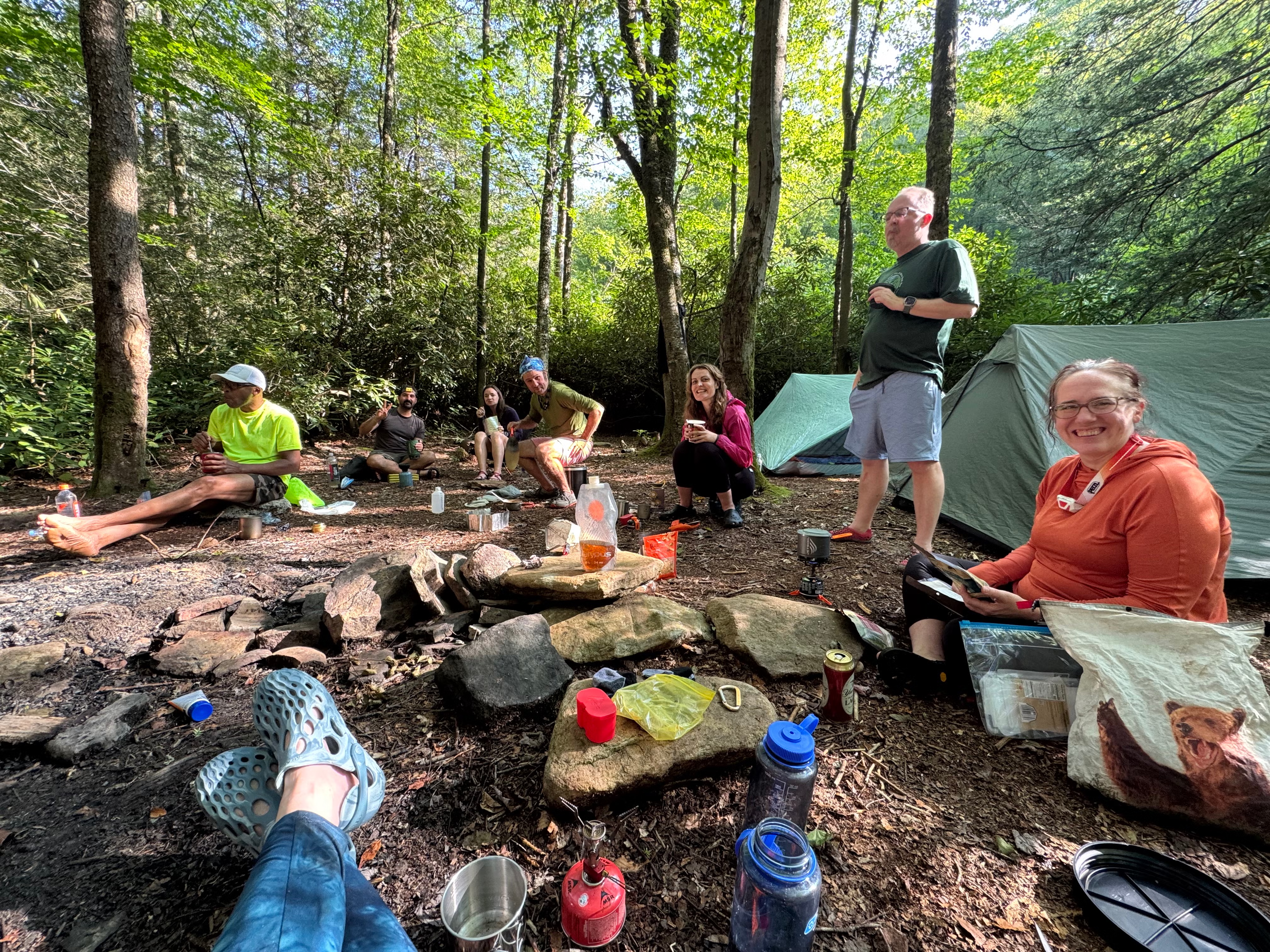
I’m excited to be a part of reintroducing DC UL Backpacking’s quarterly newsletter. Chandler is building on the great work done by Carrie Price, but he’s been putting a new and refreshed spin on it. You may have already seen articles on our blog from Maddie and Jake as they explore the flora and history of the area. As we look ahead to future editions, we’re hoping to add more features on gear we like, trails to explore, and more background on the sights and sounds of the trails we explore.
Years ago, someone told me that D.C. is underrated as an outdoors town. And it’s true – when you think of an outdoors town, most people would think of Colorado, New England, or Oregon. When you look, however, at the depth and breadth of hiking choices within a few hours drive of D.C., then you start to realize that D.C. is an outdoors town – and that DC UL trips bring you closer to those opportunities.
Needless to say, I’m looking forward to our newsletter shedding more light on our area and the latest from DC UL Backpacking. I know Chandler is going to do a great job – I hope you enjoy reading it just as much as I have.
DCUL News and Updates
Upcoming Trips/Events
Friday, October 10th — VMO: Mid State Trail: Fifth March (roughly 100 km)
Friday, October 10th — VMO: Wild Oak and Shenandoah Mountain Trail
Friday, October 17th — LM: Trout Run Valley
Saturday, October 18th — Wilderness First Aid Certification Class
Saturday, October 25th — LM: Duncan Knob and Strickler Knob (Fall Foliage Trip)
Friday, October 31st — IO: Gokyo Lake Trek, Nepal
Saturday, November 8th — VMO: AT From Dragon’s Tooth to Pearisburg
Trip Spotlight
Friday, October 17th — VMO: Four State Challenge
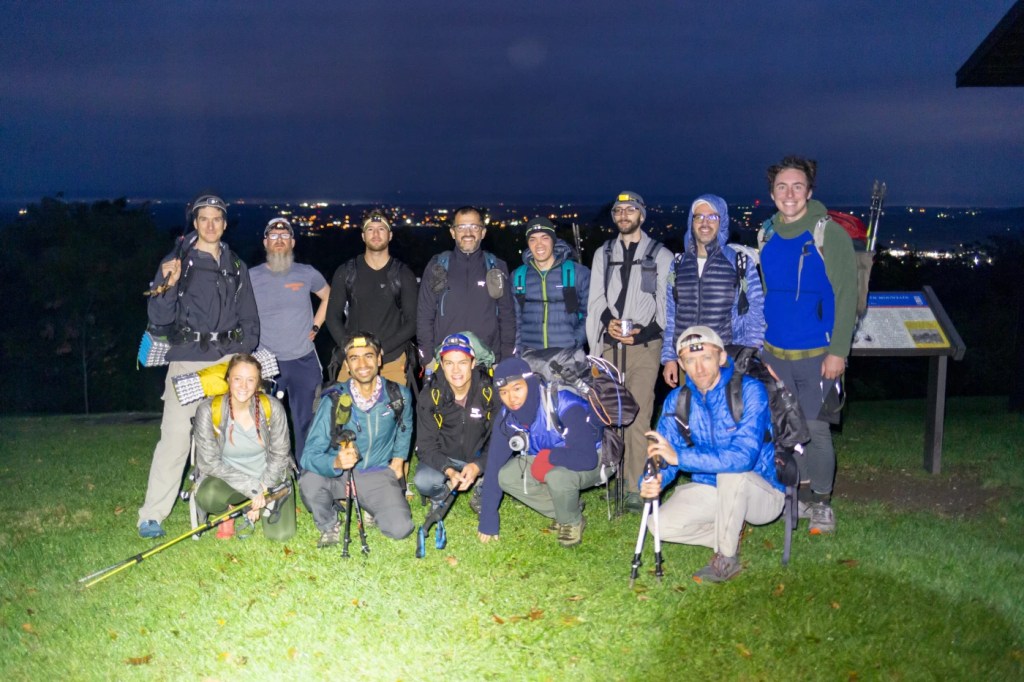
Come join us for a DCUL tradition that we have been running since 2013! Starting in Virginia, DCULers will walk through West Virginia and Maryland, and stop at the Pennsylvania border to tag four states in 24 hours. If you are a VMO member interested in hiking this, reach out to AO Emily. Trail angels are more than welcome and should coordinate times and locations in the event group chat. Good luck to all who attempt this feat!
Flora of the Fall
Maples of the Mid-Atlantic
By Maddie B
Fall is here, and hikers everywhere are looking forward to cooler weather and appreciating the lovely fall colors. All deciduous trees will experience some color change, but the leaves of a lot of our common trees like tulip poplar and hickory will turn shades of yellow and brown – nice, but not very exciting. My favorite fall color comes from maple trees, which tend to turn brilliant shades of orange and red. Maples are easy to identify while out hiking because thanks to Canada, most of us are familiar with the general shape of a maple leaf. Maple trees can also be identified from their leaves alone since they are all fairly different. There are several species of maple you might see while out hiking:

Red maple can be identified with its 3 larger center lobes pointed upward and 2 smaller bottom lobes, with serrated leaf edges all around. It also usually has reddish leaf stems (but so do other maples so it’s not a guarantee). As it gets colder, its leaves will turn a brilliant bright red.
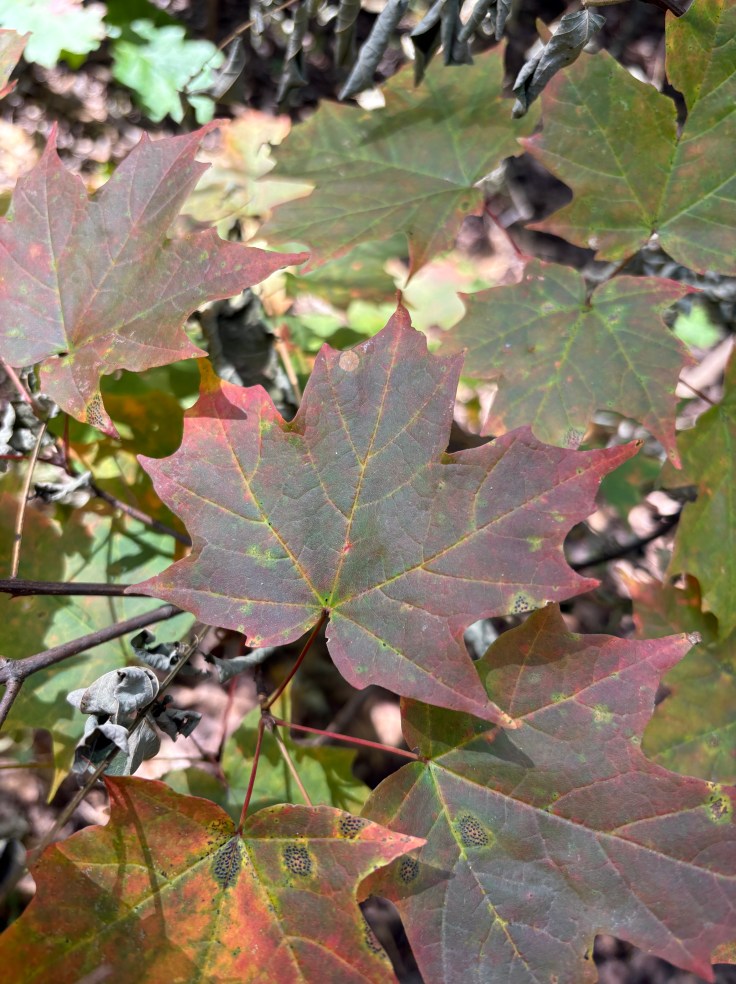
Sugar maple looks the most like the canadian flag, and is the only maple with smooth leaf edges. It has (in my opinion) the most beautiful fall display with all different shades of orange and deep red. There are two species that are very closely related to Sugar maple and have very similar looking leaves: Florida maple, which you see more in VA coastal plain, can be distinguished because the underside of its leaves are fuzzy and the leaves are generally smaller, and Black maple has more triangular pointy lobes where sugar maple lobes have a classic square shape. Sorry I have never seen those on a backpacking trip so they don’t get their own picture.

Striped maple is a smaller tree that often looks like a shrub. The bark has iconic green stripes, and the leaves have three lobes and don’t look as much like the more iconic maples. Unfortunately this one does not contribute much to fall beauty, as the leaves just turn brown and shrivel up. I took a picture of one this weekend but it was ugly so this is a leaf from earlier in the summer.
The previous three maples you will be able to find on almost every DCUL trip, and often growing right next to each other. There are four more maples you might see less commonly while out backpacking!
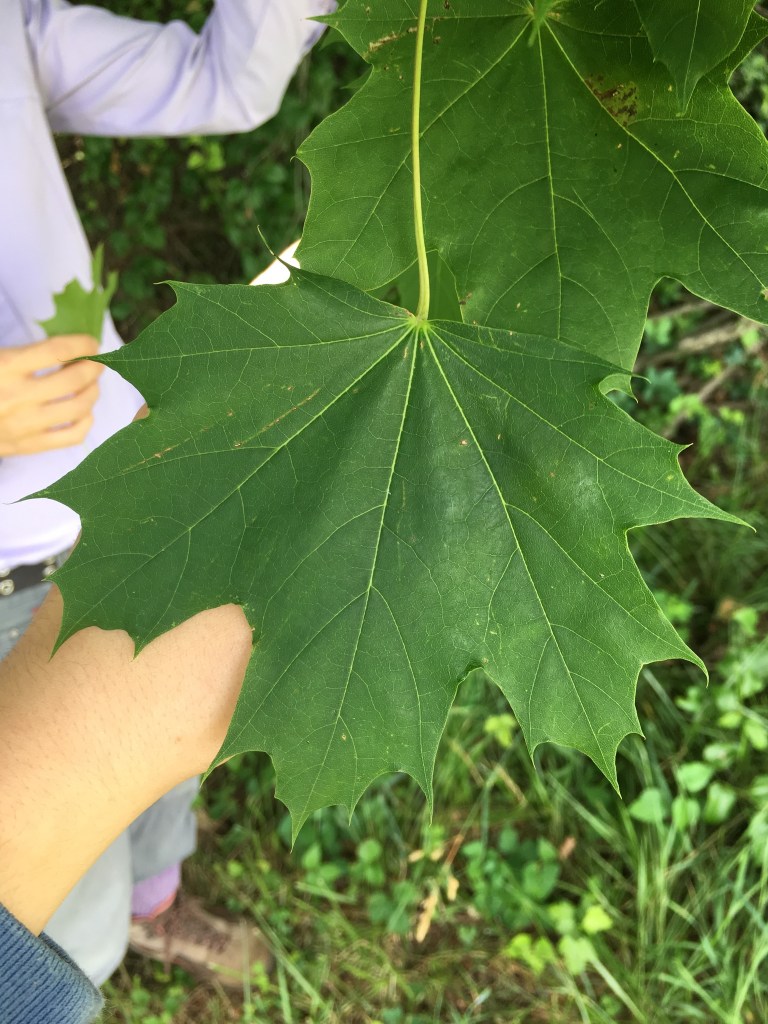
Norway maple is invasive from, you guessed it, Norway (and all of northern europe) but was commonly planted as a landscape tree. Weird choice, because we have so many types of maple at home. You can often find it in areas of old homesteads in Shenadoah. It has a smooth-edged leaf like sugar maple so I lied earlier that that was the only smooth maple leaf but it can be identified by the two little pointy spurs near the base of the leaf, so it almost looks like it has seven lobes.

Silver maple is a beautiful tree that you just don’t see while backpacking too often because it is not common in the mountains, but you can find it along the Potomac river and often planted in yards. It has deep-cut frilly leaves and the trunk often looks like it’s growing in a spiral. The leaves will turn bright yellow in the fall.

Boxelder does not even look like a maple at all. In fact, it looks a lot like poison ivy. But it is a maple, and you can tell it apart from poison ivy because it is a tree first of all and it has 5 leaflets instead of the famous 3 of poison ivy. This is another one you are less likely to see in the mountains but it is very common along rivers and in floodplains.

The final maple is Mountain maple, which grows more like a shrub similar to striped maple but I realized when writing this, I don’t think I’ve ever identified in the wild! Its leaves turn bright yellow in fall. Pennsylvania is the southern edge of its range, but it does exist in the high mountains throughout the Appalachians. Let’s keep an eye out for this uncommon maple this fall!
Hiking Through History
The Hiking Judge: William O. Douglas and the C&O Canal
by Jake S
If you talk to enough members of DCUL, you’ll find a number of lawyers in our club. If he had the chance, Supreme Court Justice William O. Douglas would have been one of them.
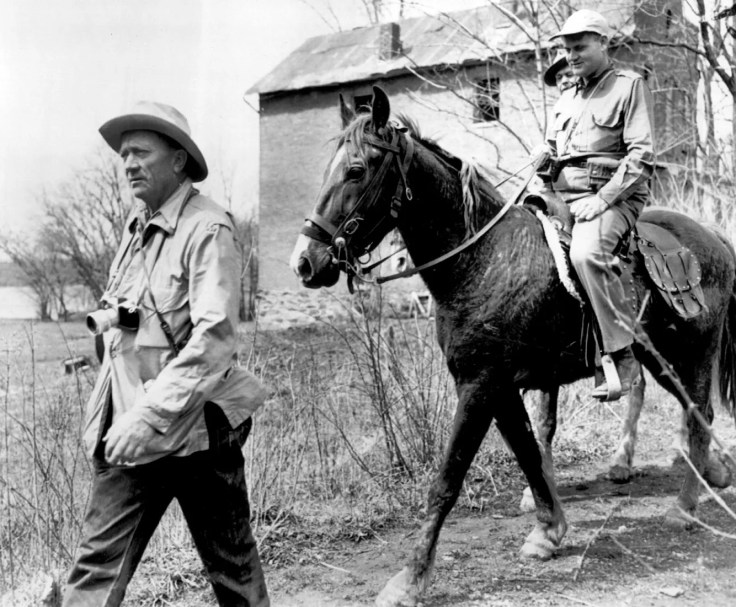
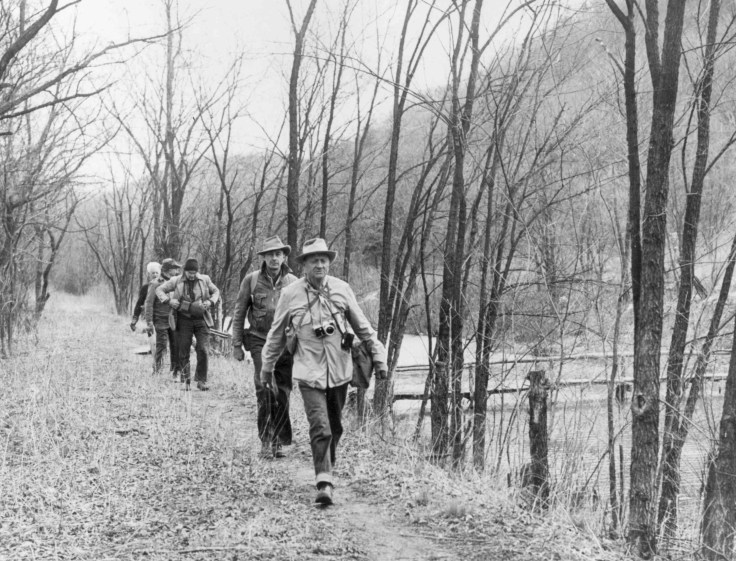
Douglas grew up in Yakima, Washington, where he hiked the mountains of the Cascade Range to strengthen legs weakened by childhood illness. Douglas moved to the east coast for law school and, at age 40, became one of the youngest justices ever appointed to the U.S. Supreme Court. Douglas kept up his active lifestyle in Washington, D.C. He often spent Sunday afternoons hiking 15 or 20 miles along the nearby C&O Canal.
Then, in the spring of 1954, the Washington Post published an editorial calling to pave the C&O Canal towpath as a scenic highway. Douglas was outraged. In a public letter to the editors of the Post, he challenged them to join him on a thru-hike of the 184.5-mile towpath. “I feel that if your editor did, he would return a new man and use the power of your great editorial page to help keep this sanctuary untouched.”
Washington Post editors Merlo Pusey and Robert Estabrook accepted Douglas’ challenge and set a start date of March 20th. Over 50 reporters, photographers, conservationists, and hikers joined them to begin the hike in Cumberland, Maryland.
Douglas set an ambitious itinerary from the start. He arrived dressed like “a nature lover who fully expects nature to fight back,” wearing “Levis, green wool shirt, high-cut boots, poplin jacket, two cameras and a musette bag.” He led the group each day, setting a brisk 4-mile-an-hour pace. On the second day, Douglas planned to cover 29 miles (VMO), but a spring snowstorm forced him to settle for a mere 21 miles (MO W2).
Associated Press reporters filed daily dispatches chronicling the mileage and terrain. The Washington Post ran the story on their front page, just below coverage of the McCarthy hearings. Many of the reporters chose to hitch in shuttles provided by the Appalachian Trail Club rather than keep up with Douglas’ 23-mile-a-day average.
At camp, hikers listened to lectures on plant identification or Potomac geology. Douglas told hair-raising stories of his western adventures, including a method for lassoing mountain lions (the trick was to “yank him to the ground” and “twist his tail in a clockwise motion”). On the last night of the trip, Douglas organized a campfire committee to draft legislation for preserving the C&O Canal as a national park.
Douglas and his party arrived in Georgetown on March 28th. Of the original 58, only 9 hikers completed the whole trail (including Douglas). Thanks in large part to his efforts, the canal remained unpaved. Congress created the Chesapeake and Ohio Canal National Historical Park in 1971.
It was not the last time “Wild Bill” Douglas used hiking for environmental advocacy. He led similar publicity hikes in Washington, Kentucky, Illinois, and Arkansas. In 1967, he led over 1,000 people on a hike to save Sunfish Pond along the New Jersey Appalachian Trail. Today, a bust of Douglass sits near the C&O Canal visitor center in Georgetown, honoring “the man who saved the canal.”
Dig Deeper:
Read Douglas’ letter to the editors of the Washington Post
Read the Time Magazine coverage of Douglas’ hike on the C&O
See photographs of Douglas on his C&O hike
Gear Reviews
Spandits: A Love Story
by Jen A
In full disclosure, I haven’t met a bright print that I haven’t liked. About two years, I was looking around for warmer leggings to wear in the winter for hiking and for cross-country skiing. The Eddie Bauer leggings are normally my go-to, but the fleece leggings weren’t quite warm enough for lower temperatures. That winter had been an especially chilly one, and we were prepping to go back to Maine for the Huts and Trails cross-country skiing trip.
Someone posed a similar question in one of New England hiking groups on Facebook. The recommendations started coming in, and several women posted a recommendation for the Icelandic tights from Spandits (https://www.spandits.com/). If nothing else, I figured women hiking the 4,000-footers in winter knew a thing or two about warm leggings. When I saw the bright patterns, I was sold. It didn’t take too much convincing for me to hit the purchase button.
Since then, I’ve worn the Icelandic tights for winter hiking and cross-country skiing. The lowest I’ve taken them has been about 15 degrees – they kept me warm while moving and offered some protection against wind, although I would add a wind-resistant layer (I have the REI Elemental full zip pants) if needed on extremely cold or windy days. They excel in colder temperatures, particularly freezing or below. They were almost too warm on a sunny day in the mid-30s.
Did I mention they have pockets?
The fleece layer is somewhat thick, which is not a problem for me. The waist has been slightly redesigned since I purchased them with a wider elastic waistband – I found the previous iteration to be comfortable, but I can see how this would be an improvement. They do run true-to-size so I would stick with your usual size. With an inseam of 27 inches, the length is a bit long but not problematic for me – you do have the option to order custom leggings to adjust the inseam length either longer or shorter.
Another selling point for me is that the company is a women-owned business based in Maine. They are runners and marathoners, so they bring that experience when creating their products. Honestly, they make me happy and keep me warm—a winning combination.
You can check out their website here.
Member Spotlight
Meet VM Austin
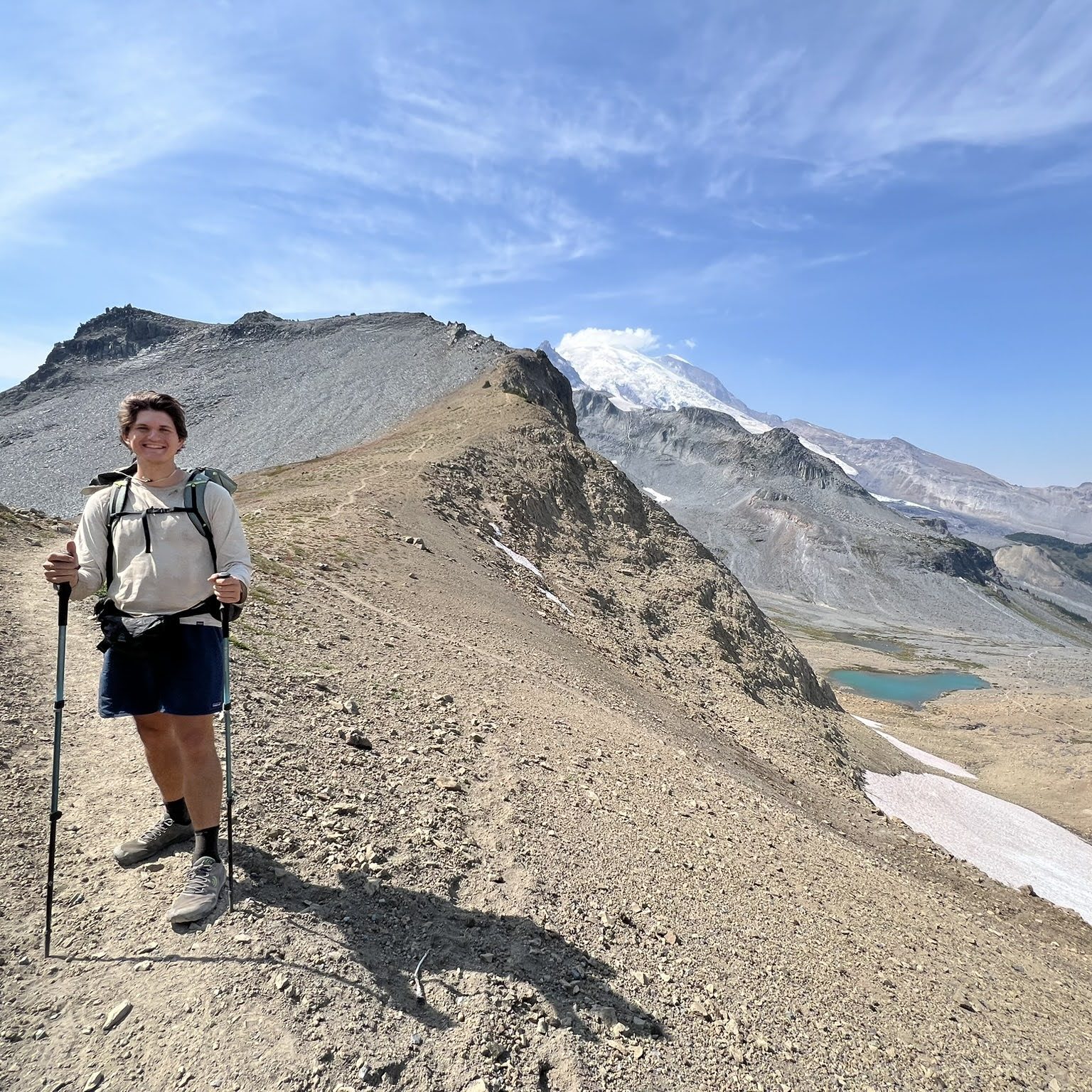
When and why did you start backpacking?
I basically got into backpacking very slowly, starting around my early college years in 2014-2015. I grew up in the other Arlington, in Texas, where hiking (and walking in general) isn’t really popular. I also wasn’t a very adventurous or active kid. But I had always loved nature so I think that is what really drew me in. My very first backpacking trip was with an Eagle Scout friend in Davy Crockett National Forest. Think flat, hot, lots of pines, some swamps. Not the most exciting genesis but luckily my bar was very low and I had a great time.
After that I learned more, mostly from the internet (Reddit, Youtube) and a used copy of The Complete Walker IV by Fletcher Collins. My first solo trip with all my own gear was at Guadalupe Mountain National Park. That was one of my favorite trips ever and it was very rewarding to make it all happen by myself. Plus I got to brag about climbing the two tallest peaks in Texas.
After that I went on 1-3 small solo trips a year for a while. These were like my “Walden” years, I was all about nature and solitude. Higher mileage and ultralight came later.
You recently did the Wonderland trail. Describe your hike in three words.
It was wonderful!
Best moment of the trip?
(Spoiler for the trip report) I’m going to say it’s a tie. I saw a bear on the trail for the first time, it was chilling in a meadow before it ran away. And I also really loved swimming in Mowich Lake, especially considering we were the only ones there (road to get there by car was closed).
How did you get involved in DC UL?
After living in the DC area for a year or so, I started getting into hiking meetups. A few people suggested the club, including U-Turn. I saw it as a nice way to blend multiple goals; get back into backpacking, make it social, go on more ambitious trips, etc. Then hiking the Tuscarora Trail on Baseball’s trips were what really got me into doing them as often as I could.
How would you define ultralight backpacking?
Hike >>> camp. Also, a magnet for interesting, fun, and slightly crazy folks.
Any “lessons learned the hard way” that you’d like to share?
Ramp up miles slowly!! Especially after a hiatus. It’s obvious but worth remembering. I think I was susceptible to this when I was between an overly cautious beginner and more experienced.
Sheetz or Wawa? And why
Sheetz just because I have been there more and their snack game has always been on point and good to me.
Meet VM Ashley
When and why did you start backpacking?
I started backpacking my senior year of college in 2016. One of my friends was doing a geology field school in Wyoming and kept sending me amazing pictures of the backcountry she was staying in, so I decided to give it a try with a local MeetUp group and loved it!
You thru-hiked the PCT. Describe your thru-hike in three words.
Fun amazing adventure
What was your PCT Trail Name?
Rise-n-shine
What has been your favorite DCUL trip so far?
The Tour du Mont Blanc trip this summer was incredible! I signed up on a whim when it was posted, and I’m so glad I was able to go!
How would you define ultralight backpacking?
Taking what you need to be safe and enjoy your trip. I think where you draw the line on that differs for everyone. If I’m hiking a lot of miles and not going to spend much time in camp, then having a lighter baseweight is a higher priority for me, in order to enjoy the hiking more. If it’s a low mileage trip and I’ll be spending more time in camp, I’m more likely to carry a few extra ounces to enjoy the camping part more. This might be controversial for DCUL but I try not to stress too much about getting to an exact baseweight if it means I’ll be miserable on the trip. I think knowing how to tailor your gear list to what you’ll be doing is the most important part.
Any “lessons learned the hard way” that you’d like to share?
I found out the importance of waterproof socks in rainy cold weather when I was doing a long hike in Montana. It had been raining on and off for about a week, and I was picking up my first resupply box at a campground that was empty except for the bin of hiker packages. I took refuge under the awning to dry out and sort my food, but eventually I had to head back out into the rain. By that time, my feet had started going numb from the cold and I ended up putting some ziplock bags on my feet in order to try and trap some heat in so I could feel my toes again.
Sheetz or Wawa? And why
I don’t think I’ve been to Wawa’s, so I’ll have to say Sheetz.
Fall Backpacking Tips
Quality sleep in the backcountry is a crucial element of any backpacking trip. We all know the feeling of tossing and turning all night, hoping to get at least one or two hours of rest. Too often, that rottiserie action that we put ourselves through persists throughout the night, and the terrible sight of first light in the morning crushes our will to hike. In fact, two years ago, I attempted the Massanutten Death March and quit after night one precisely because of my inability to get sleep. Since then, I have learned some ways to improve sleep in the backcountry that I will share with you all.
Get familiar with the environment – Sleeping outside can be an uneasy feeling for new and experienced backpackers. Arriving at camp early and walking around the campsite helps ease my senses and creates a familiarity with my surroundings that comforts me when I am trying to sleep. When lying in my tent, the knowledge of my surroundings tempers any unrealistic notion of what’s going on outside my tent.
Go to the restroom before you go into your tent – This is super simple. Force yourself to use the restroom. Waking up in the middle of the night to use the restroom sucks.
Bring a pillow – While some in the UL community will strongly discourage this, I have been bringing a pillow on my backpacking trips and gotten better sleep as a result. The Nemo Fillow Pillow is my favorite.
Choose the correct tent site – Find a flat, root-free area. Sometimes a bed of leaves underneath your tent can act as an extra cushion and insulation.
Boxed Breathing – When I struggle to sleep, I practice boxed breathing until I drift off slowly. Inhale for 4 seconds, hold for 4 seconds, exhale for 4 seconds, and then hold for 4 seconds. Simple!
Decide between a quilt or a sleeping bag – For those of us who get hot at night, a quilt might be the better option. Sleeping hot can inhibit sleep, so think about which category you fall under. On another note, please ensure you bring the appropriately rated sleeping bag or quilt.
Get oriented with your sleep system – Test your gear before heading out on the trail! When I bought a Therm-a-Rest XLite, I slept on it in my college dorm. My roommate thought it was weird, but I had a great night of sleep a week later on the trail. Actually, while using it in my dorm, I found that slightly deflating the pad proved to be more comfortable.
Earplugs/eye Mask – If you are sensitive to the sounds of nature at night, silicone earplugs could really help! I’ve also started using an eye mask to block light from the moon.
Develop good habits off trail – If you consistently go to bed at midnight in your everyday life, don’t expect to get great sleep when you start sleeping at hiker midnight (9:00 am).
Thank you for reading! Please reach out to dcul.backpacking@gmail.com if you would like to contribute to the newsletter in any way. Remember to pay your dues. You can use this link to pay: https://www.paypal.me/JenniferAdach/10
 DC UL Backpacking
Leave a comment