
Maples of the Mid-Atlantic
By Maddie Beaudry
Fall is here, and hikers everywhere are looking forward to cooler weather and appreciating the lovely fall colors. All deciduous trees will experience some color change, but the leaves of a lot of our common trees like tulip poplar and hickory will turn shades of yellow and brown – nice, but not very exciting. My favorite fall color comes from maple trees, which tend to turn brilliant shades of orange and red. Maples are easy to identify while out hiking because thanks to Canada, most of us are familiar with the general shape of a maple leaf. Maple trees can also be identified from their leaves alone since they are all fairly different. There are several species of maple you might see while out hiking:

Red maple can be identified with its 3 larger center lobes pointed upward and 2 smaller bottom lobes, with serrated leaf edges all around. It also usually has reddish leaf stems (but so do other maples so it’s not a guarantee). As it gets colder, its leaves will turn a brilliant bright red.
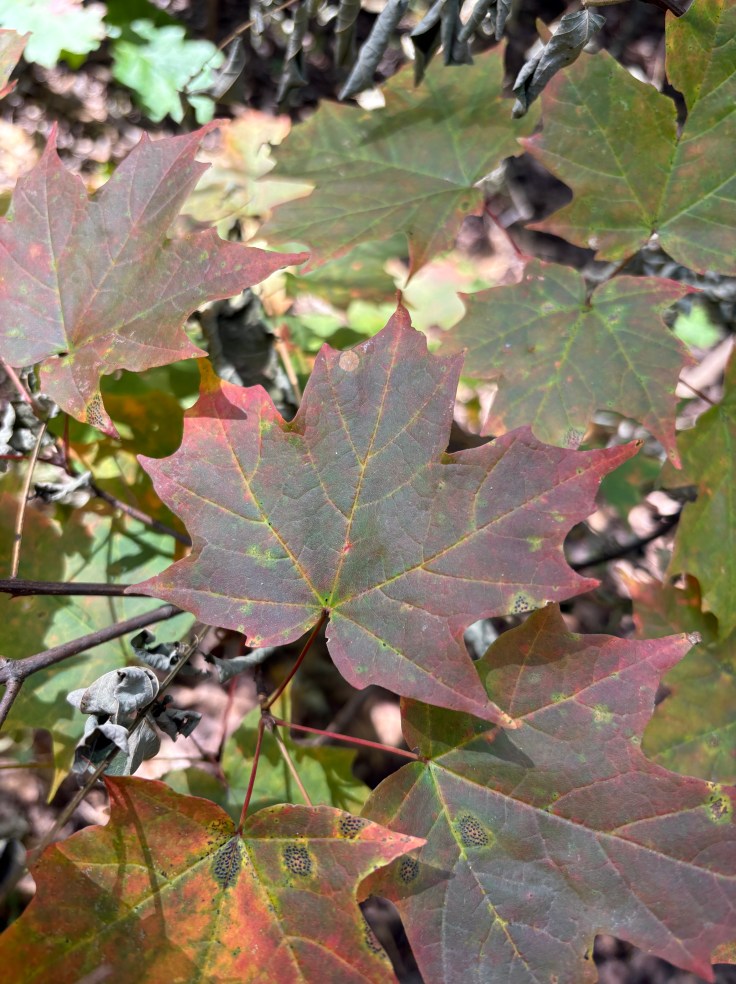
Sugar maple looks the most like the canadian flag, and is the only maple with smooth leaf edges. It has (in my opinion) the most beautiful fall display with all different shades of orange and deep red. There are two species that are very closely related to Sugar maple and have very similar looking leaves: Florida maple, which you see more in VA coastal plain, can be distinguished because the underside of its leaves are fuzzy and the leaves are generally smaller, and Black maple has more triangular pointy lobes where sugar maple lobes have a classic square shape. Sorry I have never seen those on a backpacking trip so they don’t get their own picture.

Striped maple is a smaller tree that often looks like a shrub. The bark has iconic green stripes, and the leaves have three lobes and don’t look as much like the more iconic maples. Unfortunately this one does not contribute much to fall beauty, as the leaves just turn brown and shrivel up. I took a picture of one this weekend but it was ugly so this is a leaf from earlier in the summer.
The previous three maples you will be able to find on almost every DCUL trip, and often growing right next to each other. There are four more maples you might see less commonly while out backpacking:
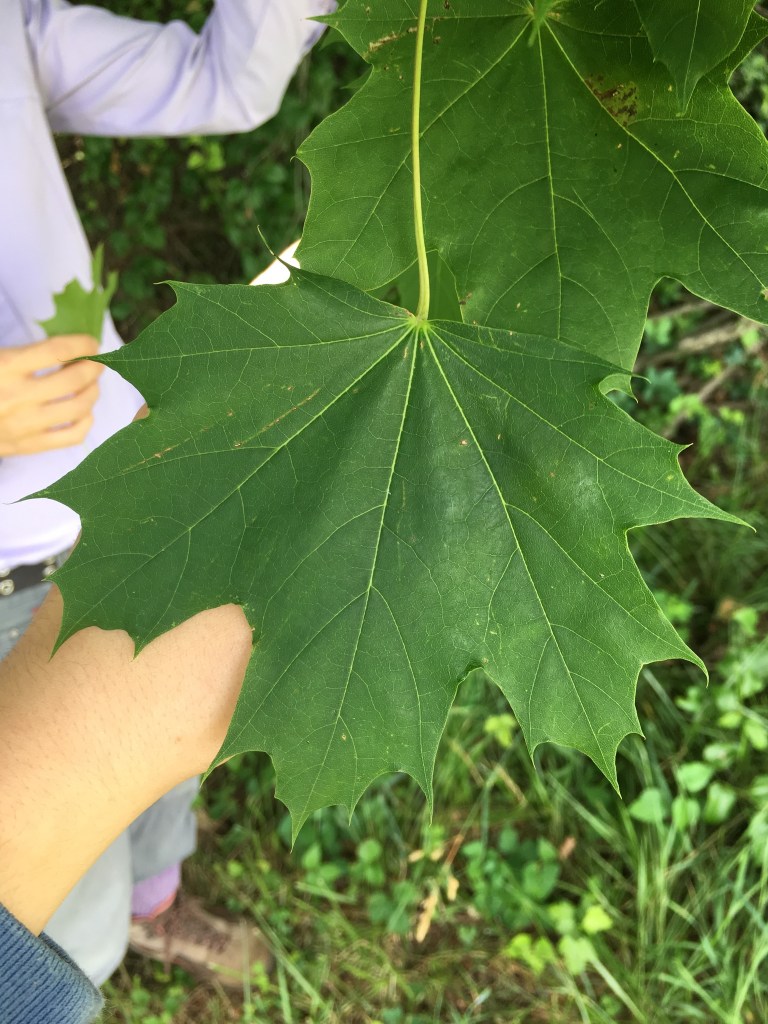
Norway maple is invasive from, you guessed it, Norway (and all of northern europe) but was commonly planted as a landscape tree. Weird choice, because we have so many types of maple at home. You can often find it in areas of old homesteads in Shenadoah. It has a smooth-edged leaf like sugar maple so I lied earlier that that was the only smooth maple leaf but it can be identified by the two little pointy spurs near the base of the leaf, so it almost looks like it has seven lobes.

Silver maple is a beautiful tree that you just don’t see while backpacking too often because it is not common in the mountains, but you can find it along the Potomac river and often planted in yards. It has deep-cut frilly leaves and the trunk often looks like it’s growing in a spiral. The leaves will turn bright yellow in the fall.

Boxelder does not even look like a maple at all. In fact, it looks a lot like poison ivy. But it is a maple, and you can tell it apart from poison ivy because it is a tree first of all and it has 5 leaflets instead of the famous 3 of poison ivy. This is another one you are less likely to see in the mountains but it is very common along rivers and in floodplains.

The final maple is Mountain maple, which grows more like a shrub similar to striped maple but I realized when writing this, I don’t think I’ve ever identified this in the wild! Its leaves turn bright yellow in fall. Pennsylvania is the southern edge of its range, but it does exist in the high mountains throughout the Appalachians. Let’s keep an eye out for this uncommon maple this fall!
Not all maples will offer a beautiful fall display every year. Fall color is caused by colored molecules in the leaf that provide sun protection throughout the year, but can’t be seen because of all the chlorophyll making green the dominant color. Trees have a hormonal clock to keep track of the amount of daylight, which is very cool but not worth explaining in this newsletter. When the days start getting shorter, chemical signals in the tree will start the breakdown of chlorophyll in the leaf and reveal the other colors that have been hiding inside. Depending on the weather conditions, sugars present in the leaf can also be used to produce more of these colored molecules. Fall weather that is dry and mild with sunny days and nights above freezing will lead to the best color production. So far it seems like we might be on track for a great fall color display this year! Thanks for reading, and I hope you get to see some maple action this fall.
 DC UL Backpacking
Leave a comment