
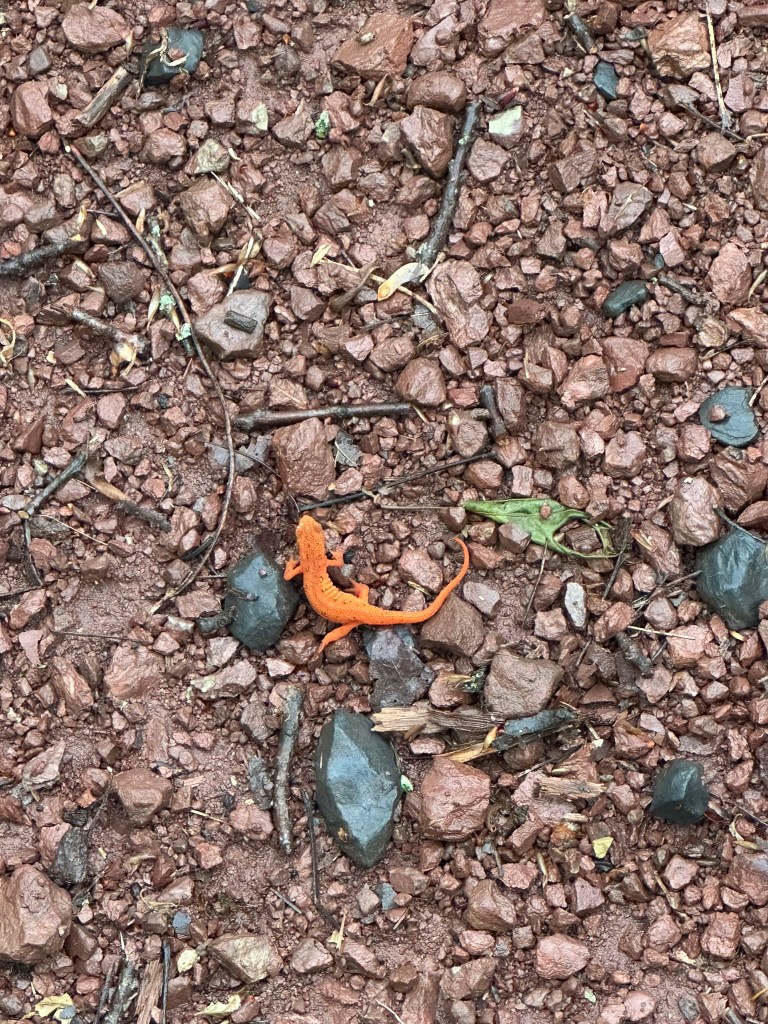
IT’S GREAT BEING RED
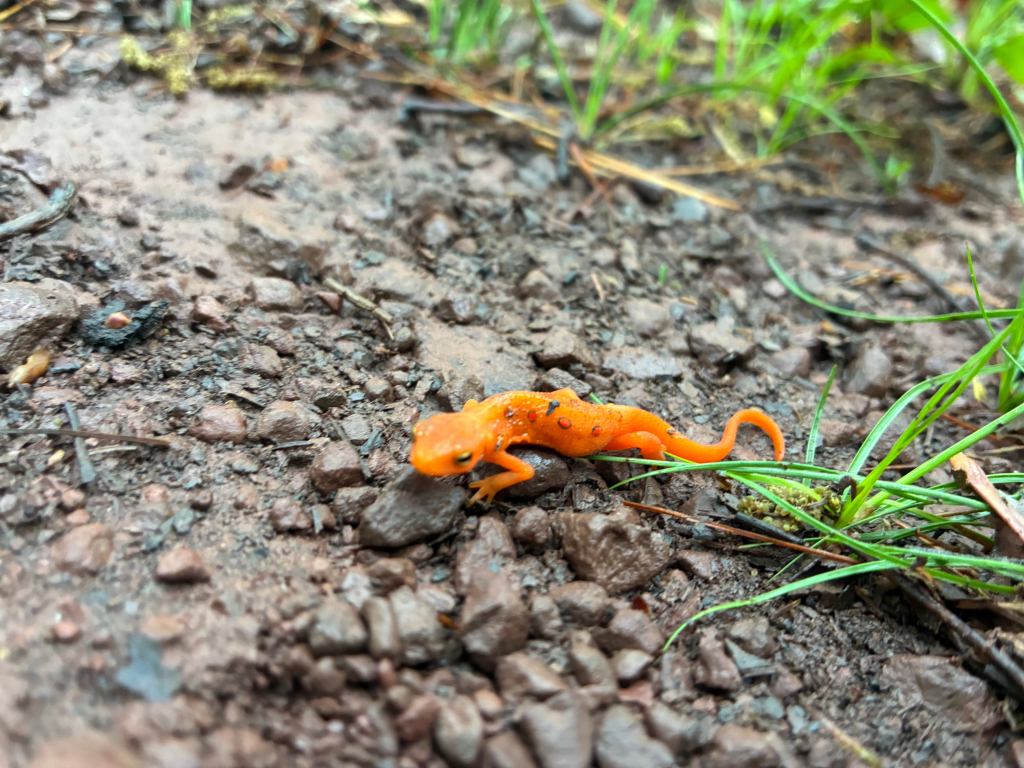
A quick disclaimer that I am not trying to match David O’s creative writing prowess of “It’s Not Easy Being Green”. This is merely an attempt to highlight another humble amphibian that became the unofficial mascot of our Wild Oak Trail hike: Red-Spotted Newt. We’ve counted 22 of these little guys on the trail and probably missed many more. As far as we know, no newts were harmed during our hike. I am not aware of their educational aspirations, but here are a few fun facts about red-spotted newts (courtesy of DCR and Wikipedia:
- The newts we saw were juveniles, called “red efts”. Their bright red color signals to predators that they are poisonous. Their skin contains tetrodotoxin, a potent neurotoxin.
- Red newts have pretty long lifespans, up to 15 years, taking almost 7 years to mature from the eft to adult stage. Adults are aquatic, but juveniles are terrestrial and like to hang out on trails. Maybe they can join us on an LM trip, they looked a bit too chill for 10 before 10.
- Newts don’t need to use Caltopo or Alltrails to find their way. They “home” by magnetic orientation, using biomagnetic material which is present in their body.
DAY 1
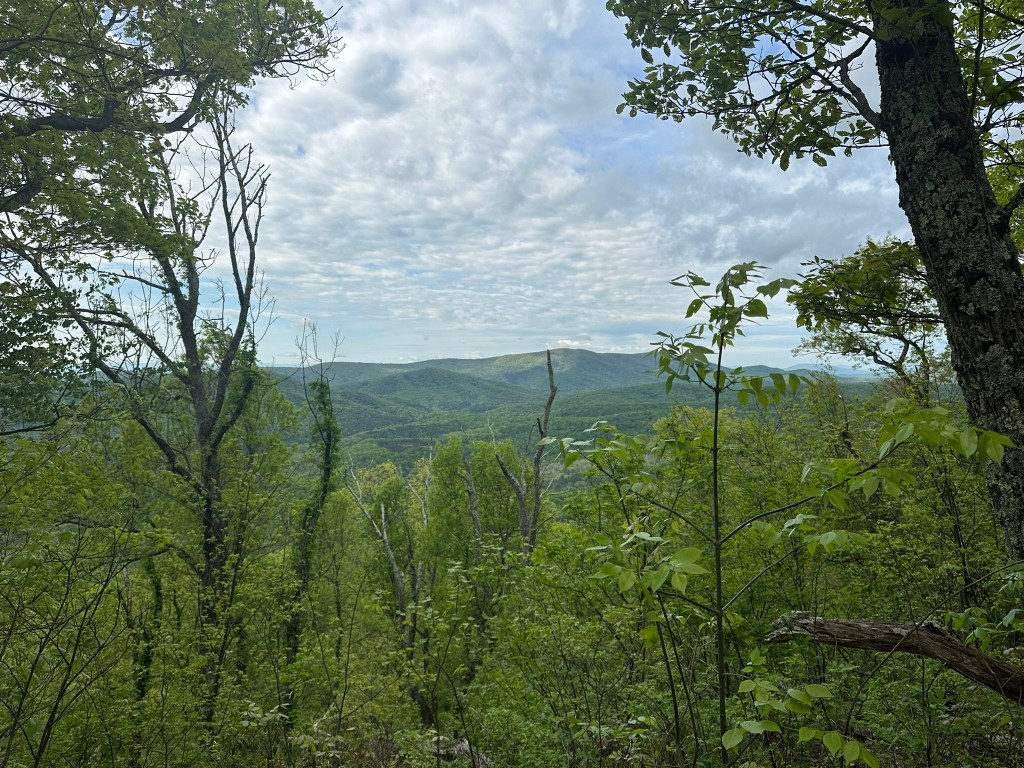
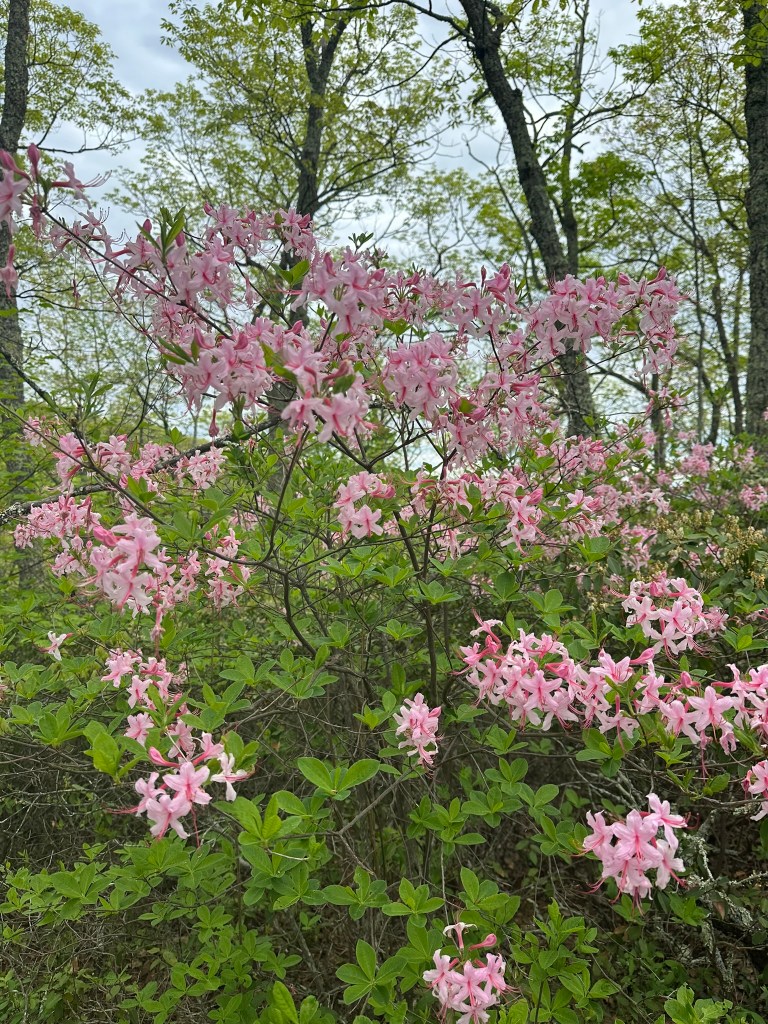
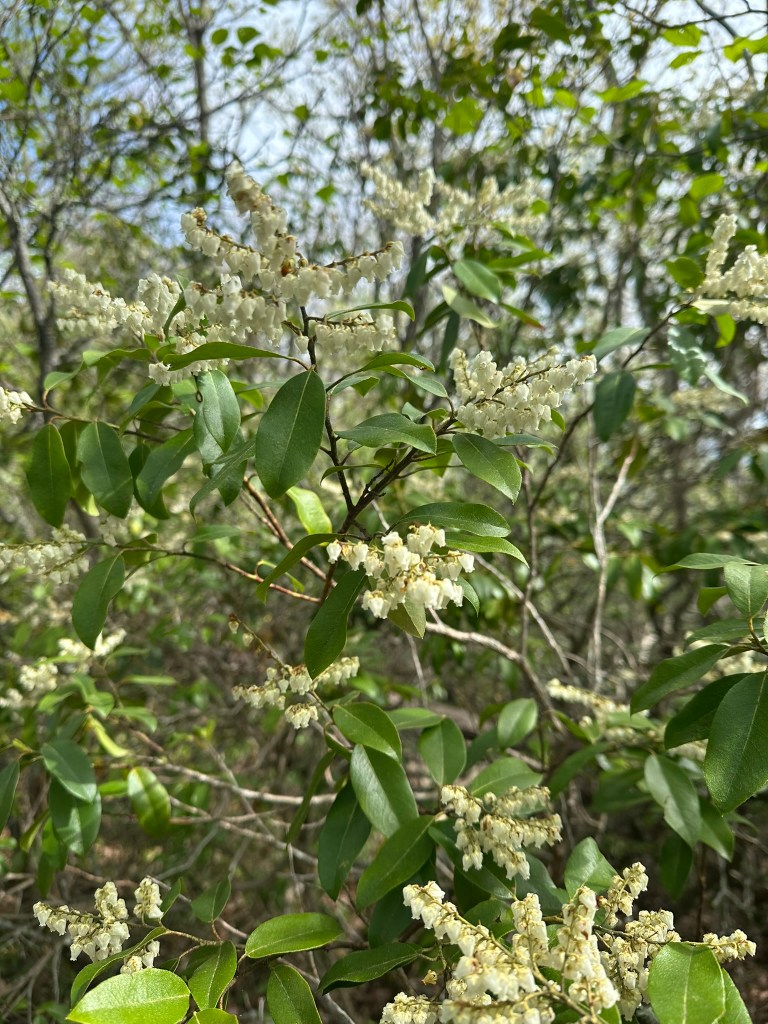
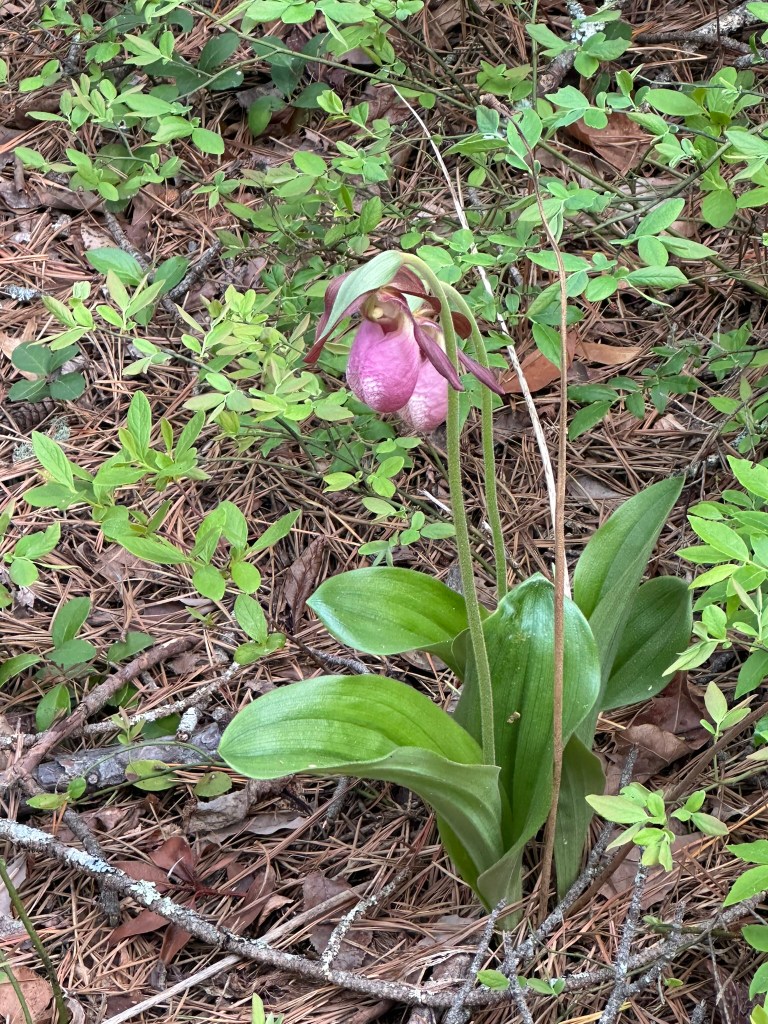
Parag, Ashley and I started the Wild Oak Trail hike at the FR 95 trailhead Saturday morning a little before 8:30 am. Ashley and Parag drove up the night before and spent Friday night at the trailhead. I left Fairfax at 6 am Saturday morning and got to the trailhead around 8 am. Originally, we planned to hike the loop clockwise, but because of potential severe thunderstorms in the forecast for Saturday afternoon and rain Sunday, I decided to reverse the route and go counterclockwise. The best views and most of the elevation change are on the stretch of the trail that passes the Little Bald Knob and the Big Bald Knob, and we didn’t want to do that part of the trail in a thunderstorm or pouring rain. Curiously, the Little Bald Knob, at 4,300ft, is 200ft higher than the Big Bald Knob at 4,100ft. Neither one is particularly bald because both of them are covered with thick vegetation at the top, so the views from the top are not the best. However, there are plenty of gorgeous views on the way up and the weather was cooperative enough for us to enjoy them. The trail is very well maintained, but very steep at times, with up to 45-degree grade. As we climbed up the trail, we passed by many blooming mountain laurels and wildflowers, including pink lady slipper orchid.
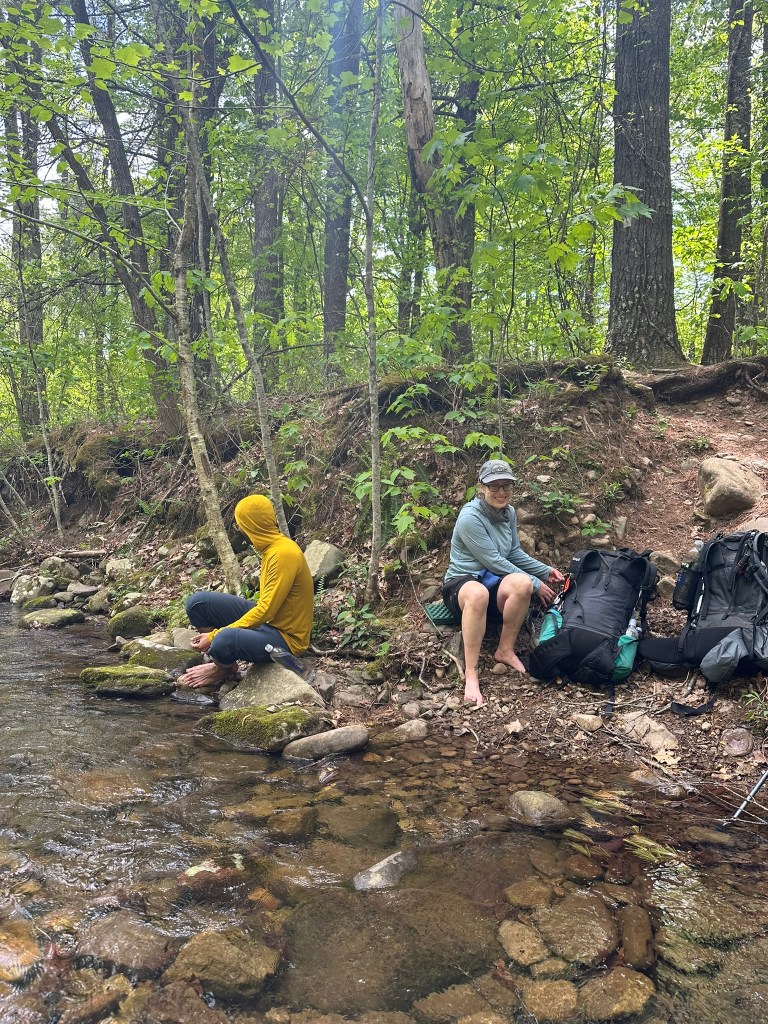
After summiting Little Bald Knob, we descended to the North River at Camp Todd. Originally, that was our campsite for the night, but because we were hiking in the opposite direction, it was just a lunch spot and an opportunity to tank up on water. Water is scarce on the Wild Oak Trail, with North River being the only reliable source. The trail crosses it twice, first time near the Rt 95 trailhead and then at Camp Todd. There are some seasonal sources and streams a short bushwack off the trail, but it’s best to fill up at the river. After Camp Todd, the trail climbs steeply up to Big Bald Knob. This is the most challenging part of the trail, with the trail climbing over 1,700ft in 2.5 miles, with grades exceeding 45 percent. The descent is almost as steep. On the way down from Big Bald Knob, Ashley realized that she didn’t have enough water for potentially dry camp that night. Luckily, Parag spotted a stream below the trail, and they were able to climb down and fill up their bottles. It was around 2 pm and the dark clouds were gathering. It started raining, but not hard and, after about 30 min of light rain, it stopped, and the sun started peeking out.
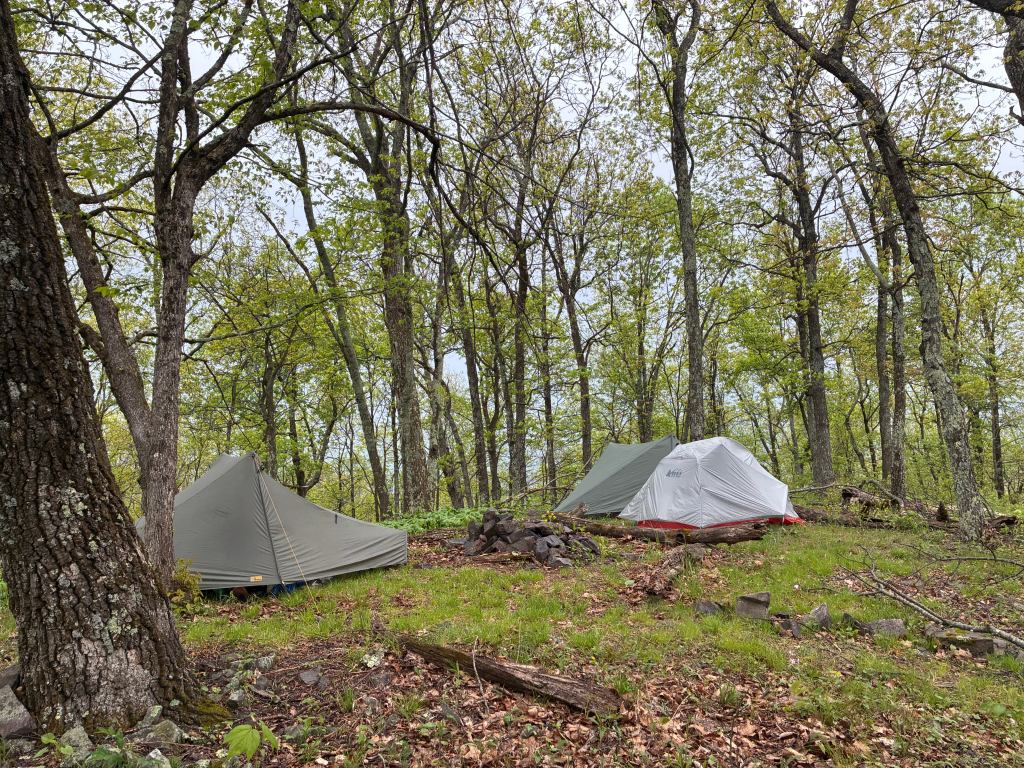
After some ridge walking and another steep climb, by about 4 pm, we had a decision to make. Parag looked up a couple of decent campsites on that stretch of the trail, all of them dry. The forecast was starting to look worse, with rain coming by 5 pm and not stopping until sometime on Sunday. There was also a potential for severe thunderstorms, although it looked like the worst of them were going to the left and right of us. Ashley and I came up on a smallish campsite that looked like it could fit our three tents. We sat down to wait for Parag and were immediately greeted by a small army of gnats who seemed to entertain themselves by trying to get in our eyes and noses. After a while they lost interest and disappeared, maybe they felt the rain coming. Parag arrived shortly and, after short deliberation, we decided it was wise to stay at the campsite instead of pushing forward. The rain was expected to start any minute and, having covered 18.5 miles with 6,300ft elevation change, we didn’t feel cheated. We found a few flat spots and barely had time to pitch our tents before it started raining. There were a few downed trees and branches around, so we were hoping for no strong winds or bad storms. Luckily, there was no wind, just steady rain, sometimes heavy, that continued from 5 pm all the way through the night. We stayed in our tents all evening, I didn’t even feel like coming out and cooking my ramen. Luckily, there was decent cell service on the ridge, so I was able to catch up on my Stanley Cup playoffs watching.
Day 2
I woke up at 5:30 am and checked the Weather Channel, not feeling too hopeful about the weather. To my delight, the forecast changed, and all the rain was supposed to clear out by 7 am. We waited in our tents until the rain stopped and then packed up. Unfortunately, Parag’s tent let in some water and his gear got wet overnight. I think there may be a Durston X-Mid in his future. We got back on the trail before 7:30 am. It was a bit late for 10 before 10, but we did not aspire to setting any DCUL speed records. After a lot of climbing the previous day, it was a very easy 10 miles, with only around 1,000ft ascent. The trail was a mix of wooded single track and old forest roads, with a few rocky sections thrown in. We walked past a few large puddles populated by tadpoles and then hit the “salamander highway”. At least we initially thought they were salamanders, but the little creatures turned out to be juvenile red-spotted newts. They adorably sat in the middle of the trail, blissfully unaware of passing DCULers who are known for flattening their amphibian relatives (RIP Kermit of the C&O Canal tow path). Ashley entertained us counting the baby newts. By the time we reached the end of the trail, she counted 22 of them.
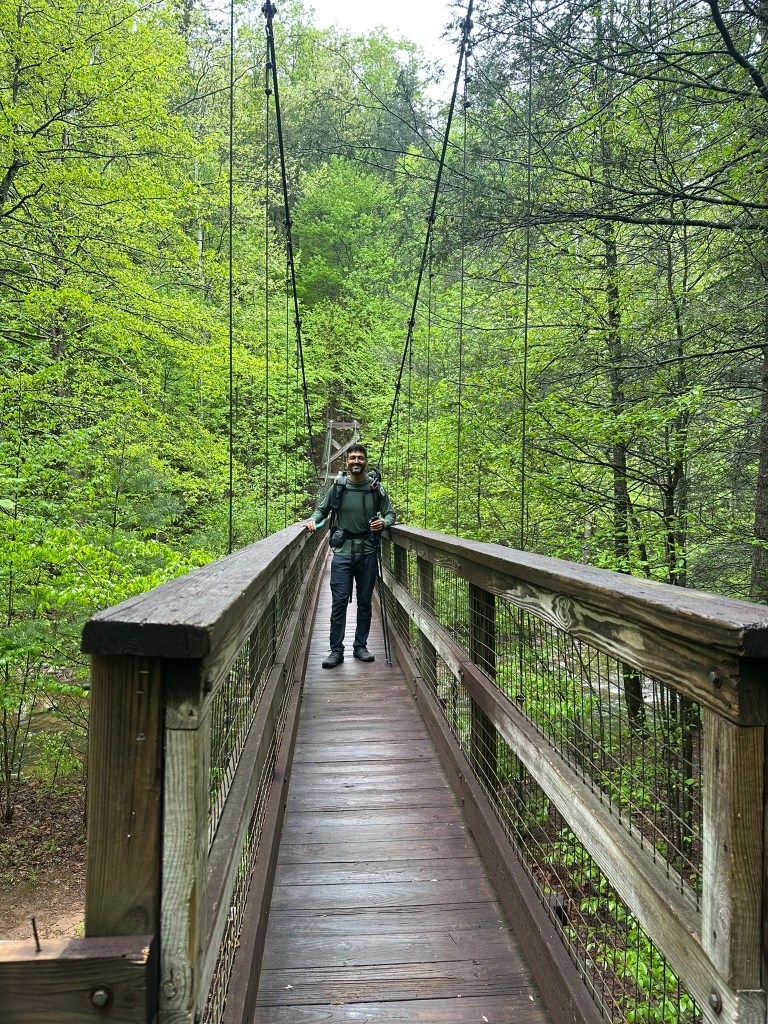
We crossed North River on a cute suspension bridge and, after a short walk on the road, arrived back to the parking lot. We changed, cleaned up a bit and drove to Cracked Pillar brewpub in Bridgewater, which served delicious (but expensive) burgers and beer. It was a nice conclusion to an overall great hike on a beautiful trail. Wild Oak loop is definitely a keeper. It can also be combined with Ramsey’s Draft wilderness and Shenandoah Mountain for a longer trip. I definitely see doing it in the fall when the leaves start turning.
Til next time, Veronica “Fairweather” Crawford
 DC UL Backpacking
That was a terrific trip report! I felt as if I was there, and had a good laugh. My only suggestion is for more character development for the newts.
LikeLike